
Zoho Agent Architecture
A system‑first architecture designed for trust, control, and production execution
Revenue AI only works when agents are governed as part of a system. In Zoho environments, Growthline designs agent architectures that prioritize deterministic execution, clear delegation boundaries, and tool‑truth enforcement.
This page explains how Revenue AI agents are structured, orchestrated, and governed inside Zoho—so execution is observable, auditable, and safe to run in production
Architecture Principles
Zoho Revenue AI architectures are designed around a small set of non‑negotiable principles:
- System first — Zoho CRM and connected tools remain the source of truth
- Task‑specific agents — no generalist agents or improvisation
- Deterministic execution — predictable behavior under defined conditions
- Explicit authority — agents act only within delegated scope
- Observable actions — nothing executes silently
These principles prevent brittle behavior and build trust over time.
Core Architectural Components
Orchestration Layer
The orchestration layer coordinates agent activity without performing execution itself. It is responsible for:
- Routing tasks to the correct agent
- Managing execution order and dependencies
- Enforcing approval requirements
- Capturing execution outcomes and errors
Orchestration provides control without centralizing intelligence in a single agent.
Task‑Specific Agents
Each agent is responsible for a narrowly defined function, such as:
- Sales Development (SDR)
- Account and Contact Research
- CRM Operations and Data Hygiene
- Email and Calendar Execution
Agents are not permitted to act outside their assigned scope. This separation of responsibilities eliminates ambiguity and prevents unintended actions
Zoho as the System of Record
All execution occurs directly inside Zoho CRM and connected Zoho services. Zoho remains authoritative for:
- Contact and account data
- Activity history
- Workflow state
- Meeting and scheduling records
Agents write results back to Zoho immediately, ensuring data consistency and auditability
Human‑in‑the‑Loop Control
Human oversight is structurally embedded in the architecture.
Depending on the workflow, this may include:
- Approval before outreach is sent
- Confirmation before meetings are scheduled
- Escalation when required inputs are missing
- Review of surfaced errors or conflicts
This ensures teams maintain control without becoming execution bottlenecks
.
Tool Truth and Error Handling
Revenue AI agents are governed by a strict tool‑truth rule:
- Agents never claim actions they did not perform
- CRM, email, and calendar systems remain authoritative
- Failures are surfaced explicitly, not summarized away
Errors, partial execution, and edge cases are treated as first‑class system events.
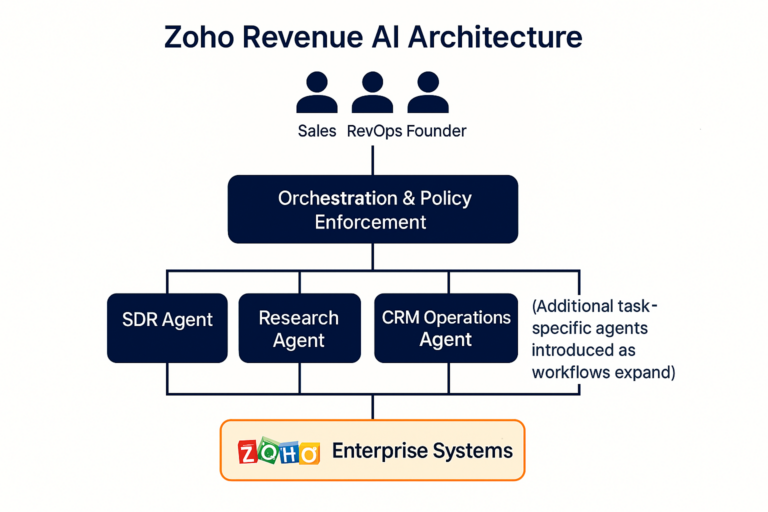
Example: Zoho Revenue AI Architecture
(Diagram: Zoho Revenue AI Architecture — Orchestration, Agents, and System of Record)
This diagram illustrates how orchestration, task‑specific agents, and Zoho systems interact while preserving clear execution boundaries and human oversight
Why This Architecture Matters
Revenue AI systems fail when agents are over‑empowered, under‑observed, or loosely governed. A system‑first architecture ensures that automation strengthens Zoho over time rather than degrading data quality or trust.
This approach allows Revenue AI to scale safely—from a single workflow to broader revenue operations—without re‑architecture.
Related Zoho Revenue AI Pages
- Zoho Revenue AI Overview – Why Zoho is the fastest path to production
- Zoho AI SDR – How the SDR agent operates inside Zoho
- Zoho Use Cases – Common workflows and expansion paths
- Zoho AI Readiness – Preconditions for safe deployment
Interested in how this architecture would apply to your Zoho environment?
Start with a conversation focused on a single workflow.
Click Here