
Revenue AI that actually runs inside your revenue systems
Revenue AI systems for B2B growth

Revenue AI is not a tool, a chatbot, or a layer of automation. It is a system of autonomous and semi‑autonomous agents designed to execute revenue work inside live platforms—CRM, email, and calendars—with explicit boundaries, deterministic behavior, and human oversight.
This page explains how Revenue AI actually operates in production…Continue Reading
How Revenue AI Works
What We Mean by “Revenue AI”
Definition
Revenue AI is the use of autonomous and semi‑autonomous agents to execute revenue operations tasks—such as research, outreach, CRM updates, and scheduling—directly inside live enterprise systems.
What Revenue AI Is
Revenue AI consists of agents that take action, not dashboards or analytics layers.
These agents operate inside core systems such as CRM platforms, email, and calendars.
Revenue AI is designed for sales teams, revenue operations leaders, and founders who need execution, not experimentation.
What Revenue AI Is Not
Revenue AI is not chatbots.
It is not prompt experiments or conversational demos.
It is not standalone SaaS tools operating outside enterprise systems.
The Problem Revenue Teams Are Actually Facing
Revenue teams are not struggling because they lack AI tools. They are struggling because the work required to run revenue operations still depends on manual effort, fragile processes, and human follow‑through.
Sales teams remain buried in administrative work—logging activity, updating CRM records, coordinating follow‑ups—work that pulls time away from selling. CRM data decays because updates are optional, delayed, or skipped entirely. Founder‑led sales motions work early but break as volume increases, because execution lives in one person’s head rather than in systems.
At the same time, many AI tools can talk, summarize, or recommend—but cannot take action. They sit outside the systems where revenue work actually happens, creating insight without execution.
The issue isn’t a lack of AI.
It’s a lack of AI that can safely operate inside revenue systems.

How Growthline Approaches Revenue AI (System First)
Built as systems. Deployed in production. Governed by design.
A. Agent‑First Architecture
Revenue AI systems are built from task‑specific agents, each responsible for a clearly defined function such as sales development, research, CRM updates, or email execution. Agents are not generalists. They are delegated authority within explicit boundaries.
Each agent operates under deterministic execution rules. Actions are predictable, traceable, and repeatable. This eliminates brittle behavior and prevents agents from improvising outside their scope.
The result is an architecture that scales safely as volume increases, without relying on fragile prompt logic or human memory.
B. Human‑in‑the‑Loop by Design
Human oversight is not bolted on after the fact. It is designed into the system.
Approval points are explicit. Actions are observable. Agents surface what they intend to do and what they have done. Nothing executes silently.
This ensures that teams maintain control without becoming the bottleneck, enabling trust in automation without surrendering accountability.
C. Tool Truth and Governance
Agents are governed by a strict principle: they never claim actions they did not perform.
CRM systems and email platforms remain the sources of truth. If an action fails, errors are surfaced clearly rather than hidden behind summaries or optimistic language.
This eliminates “phantom execution” and preserves data integrity—an essential requirement for any revenue system operating in production.
Where We Start: Revenue AI for Zoho
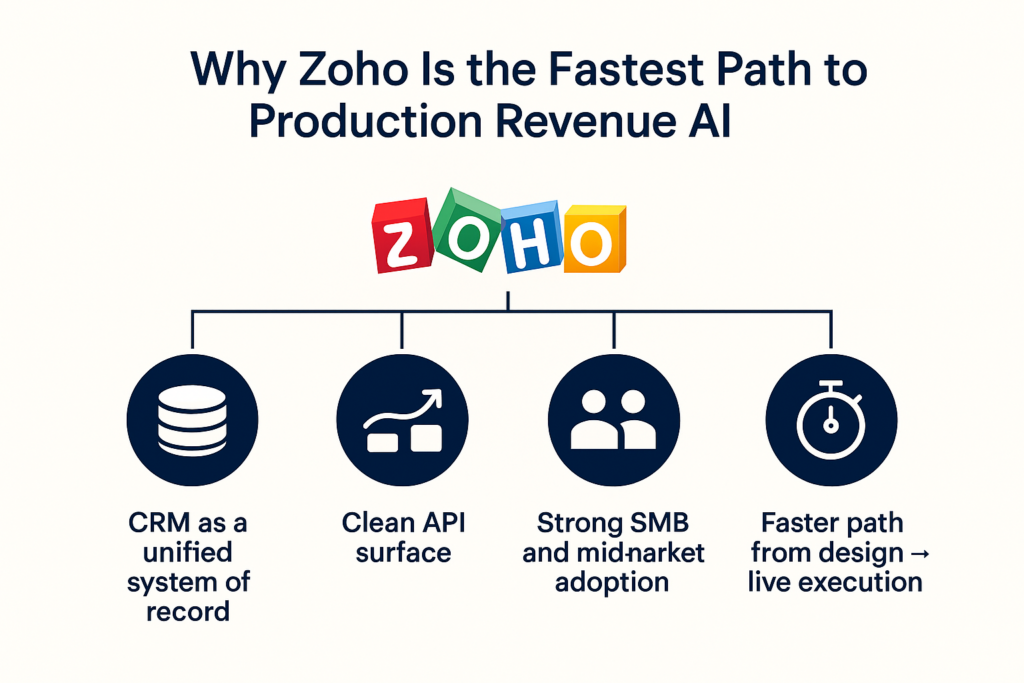
Why Zoho Is the Fastest Path to Production Revenue AI
Revenue AI succeeds or fails based on how well it can operate inside real systems. Zoho provides one of the cleanest paths from design to live execution because it functions as a genuinely unified system of record across sales, marketing, and operations.
Zoho CRM offers a consistent data model, a clean API surface, and native integration with email and workflows. This allows Revenue AI agents to take action—researching, updating records, sending outreach, scheduling—without brittle workarounds or disconnected tools.
Combined with Zoho’s strong adoption in SMB and mid‑market organizations, this creates an environment where Revenue AI can move from concept to production quickly. Teams can deploy agents safely, observe behavior, and scale execution without rebuilding their revenue stack.
Explore Revenue AI for Zoho…
What Revenue AI Can Do Today
Capabilities built for execution, not experimentation
Revenue AI is most effective when applied to well‑defined operational work. Today, it delivers the most value in areas where execution is repetitive, time‑sensitive, and tightly coupled to systems of record.
Rather than claiming universal automation, Growthline deploys Revenue AI in bounded capability areas where outcomes can be observed, governed, and trusted.
A. Sales Development
Revenue AI supports sales development by handling the execution layer of outbound and follow‑up work—without removing human judgment.
Agents can:
- Research target accounts and contacts using structured and unstructured data
- Draft personalized outreach grounded in account and role context
- Execute follow‑ups and sequencing based on defined rules and timing
- Coordinate meeting scheduling inside live calendars
This reduces administrative burden while preserving sales ownership and intent.
B. CRM Operations
Revenue AI strengthens CRM reliability by taking responsibility for the work that is most often delayed, skipped, or inconsistently applied.
Agents can:
- Create notes and log activities automatically based on executed actions
- Update contact and account records with validated information
- Perform ongoing data hygiene and enrichment inside the CRM system
By operating directly within the system of record, Revenue AI improves data quality without relying on manual discipline.
C. Revenue Intelligence (Emerging)
Revenue intelligence capabilities are developing more cautiously, with a focus on assistive—not autonomous—use cases.
Today, Revenue AI can:
- Detect signals across accounts, activity, and engagement
- Generate opportunity and account context summaries
- Support sales and RevOps workflows with surfaced insights
These capabilities are designed to augment decision‑making rather than replace it, with clear boundaries around execution.
Platforms We Work With




Chosen for execution, not experimentation
Growthline works with a deliberately constrained set of platforms that are proven, extensible, and capable of supporting production‑grade Revenue AI. These are not marketplace integrations—they are systems where agents can operate safely, observably, and at scale.
Zoho CRM (Primary)
Zoho CRM serves as the primary system of record for many Revenue AI deployments. Its unified data model, workflow engine, and API surface allow agents to execute sales development, CRM operations, and revenue workflows directly inside the system—without fragile workarounds.
Zoho enables faster movement from design to live execution while maintaining governance and data integrity.
Microsoft 365 (Outlook, Teams)
Microsoft 365 provides the execution layer for communication and coordination. Revenue AI agents operate directly within Outlook and calendars for email, scheduling, and follow‑ups, while Teams supports visibility and human‑in‑the‑loop workflows.
Email and calendar systems remain sources of truth, ensuring actions are real, observable, and auditable.
LinkedIn (Enrichment Workflows)
LinkedIn is used selectively as an enrichment and research surface, not a system of record. Revenue AI leverages LinkedIn data to support account and contact research workflows that feed downstream execution inside CRM and email systems.
This keeps enrichment contextual while preserving data governance.
Agent Frameworks (Lyzr)
Agent frameworks such as Lyzr are used to implement task‑specific, governed agents with clear delegation boundaries. Frameworks are chosen based on their ability to support deterministic execution, tool truth, and integration with enterprise systems—not for experimentation or novelty.
Why Revenue AI Fails (And How We Avoid It)

Designed like a revenue process, not an experiment
Most Revenue AI initiatives fail for predictable reasons. Not because the technology doesn’t work — but because it’s applied without the discipline required to operate inside real revenue systems.
Growthline avoids these failures by designing agents the same way you would design a revenue process: minimal, explicit, and testable.
Common Failure Modes
Over‑Prompting Instead of System Design
Many teams attempt to solve execution problems with longer prompts and more instructions. This creates brittle behavior, inconsistent outcomes, and systems that only work when phrased “just right.”
Revenue AI fails when intelligence is substituted for structure.
Instruction Overload (“Don’t Do This”)
Layering prohibitions and edge‑case rules leads to agents that hesitate, stall, or behave unpredictably. When agents are governed by what they shouldn’t do instead of what they are allowed to do, execution breaks down.
No Clear Execution Authority
If it’s unclear what an agent is permitted to execute — and where — automation either overreaches or never acts at all. Revenue AI fails when responsibility is ambiguous and delegation boundaries are undefined.
No Visibility Into Actions Taken
Systems lose trust when teams can’t see what actions were executed, what failed, or what was skipped. “Black box” automation erodes confidence and undermines adoption.
How We Avoid These Failures
Growthline approaches Revenue AI as an operational discipline, not a prompt‑engineering exercise.
We:
- Design agents with explicit scopes of authority
- Prefer positive, declarative rules over restrictive instruction layers
- Build observable execution paths into CRM, email, and calendar systems
- Surface errors and edge cases instead of hiding them behind summaries
Every agent is designed to do a small set of things reliably, inside defined systems, with clear accountability.
Why This Matters
Revenue AI earns trust by behaving like a well‑designed revenue process: predictable, inspectable, and improvable over time.
By prioritizing system design over prompt complexity, Growthline delivers Revenue AI that works in production — not just in demos.
How Engagements Typically Start
Designed to prove value before expanding scope
Growthline engagements begin with a narrow, well‑defined revenue workflow. Rather than attempting broad automation upfront, we focus on a specific area where execution friction is visible and outcomes can be observed.
This allows Revenue AI to be deployed quickly, safely, and inside live systems from the start.
Step 1: Identify a Narrow Revenue Workflow
We start by selecting a single workflow that is repetitive, time‑sensitive, and operationally clear—such as sales development follow‑ups, CRM updates, or meeting coordination.
The goal is not transformation. It is controlled execution.
Step 2: Deploy a Minimal Working Agent
A task‑specific agent is deployed with explicit scope and authority. The agent is designed to do a small number of things reliably, inside defined systems, with clear approval points where required.
This establishes a working baseline without introducing unnecessary complexity.
Step 3: Observe Behavior in Production
Once live, agent behavior is observed directly inside CRM, email, and calendar systems. Actions, errors, and edge cases are surfaced and reviewed.
This phase is about validation: confirming that the system behaves predictably under real conditions.
Step 4: Expand Deliberately
Only after execution is proven do we expand scope—adding workflows, increasing autonomy, or introducing additional agents.
Each expansion builds on demonstrated behavior, not assumptions.
Why this approach works
Revenue AI earns trust by working reliably in small ways before doing bigger things. By starting narrow and expanding deliberately, teams gain confidence without risking system integrity or data quality.
This is how Revenue AI moves from concept to production—without disruption.
Talk to us about Revenue AI